Friday, 25 October 2013

Summer's colours

summer’s colors

bending light

finding beauty

taking flight  

- unknown 


The season's first Marigolds have appeared after we had our (late) spring rains a couple of weeks ago. They are always first to add bright splashes of colour to the garden and it's amazing that these, often regarded as simple, little flowers can provide so much pleasure. And not only do they fill empty spots beautifully, they also keep all sorts of harmful insects at bay. Farmers and gardeners have long known that marigolds make important companion plants all over the garden. Not only does the scent of the marigold (Tagetes spp.) repel animals and insects, but the underground workings of the marigold will repel microscopic worms and other pests for up to 3 years.

No annual is more cheerful or easier to grow than marigolds. These flowers are the spendthrifts among annuals, showing a wealth of gold, copper, and brass into our summer and autumn gardens. Marigolds form the backbone of many plantings because of their diversity and adaptability. Use them freely in beds, borders, edges, pots, and boxes. They grow in almost any soil but do need lots of sunshine. Seeds sown directly into the garden about 1-inch apart sprout within days in warm weather and plants bloom in about 8 weeks.

But be warned! Their seeds are dispersed by the wind and if you are a fussy gardener, you might not be pleased that they suddenly appear all over the garden where you might not want them. Since putting in a few seeds a couple of years ago, I have never bought or planted marigolds again!


All the deciduous trees are also now dressed in their finest greenery and the soft green of the new Celtis africana (White Stinkwood) leaves look beautiful against the backdrop of the darker Karee lancea (Black Karee) leaves. The Acacia karroo (Sweet thorn) also pushed out their brand-new little leaves the day after our first shower.

Celtis africana (White Stinkwood)

Acacia karroo (Sweet thorn)


The thorns of the Acacia karroo are always an indication of how much water it gets - during the rainy season my thorns are always huge and fat. The sweet thorn gets its common name from the gum which is exuded from wounds in the bark. This pleasant tasting gum is eaten by people and animals, including the Lesser Bushbaby which feeds exclusively on insects and gum from trees, particularly acacia trees. And that reminds me, I haven't seen any Bushbabies for years, they used to be regular visitors to my garden... The same with Chameleons...

Flowers of the Acacia karroo usually appear early summer or after good rains, so I'm looking forward to these lovely little puff-balls!

The sweet thorn makes a beautiful garden specimen. The bright yellow flowers look very striking against the dark green foliage. The rough, dark brown bark is also most attractive. The flowers are sweetly scented and are renowned for attracting insects which are essential to any bird garden. Birds also like to make nests in thorn trees as the thorns offer them some protection from predators. Caterpillars of 10 species of butterflies are dependant on the tree for survival. These include, the club-tailed charaxes (Charaxes zoolina zoolina) and the topaz-spotted blue (Azanus jesous).


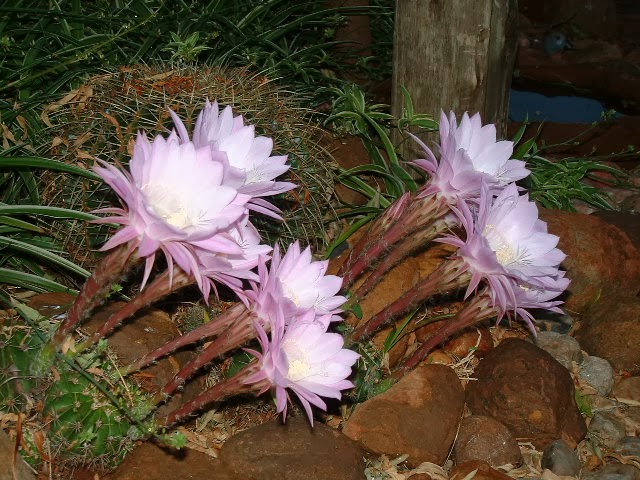
Flower of the Echinopsis cactus

Echinopsis are cacti native to South America, sometimes known as hedgehog cactus. They are fairly ball-shaped and can spread fairly fast, forming clumps of individual cacti that can be lifted and transplanted. They are renowned for their amazing flowers, often giant … 5″-6″ in diameter … and frequently dwarf the cactus that they grow on. Mine carry pink flowers but they come in reds, violets, oranges, yellows and numerous mixtures. Such a shame they only last a day or two after opening, though I guess that really makes them all the more special.

Lots of babies from just two mother plants


Pic taken 5am this morning

 It's amazing how one can water the garden every day for weeks and then just 20mm of rain and everything springs to life!

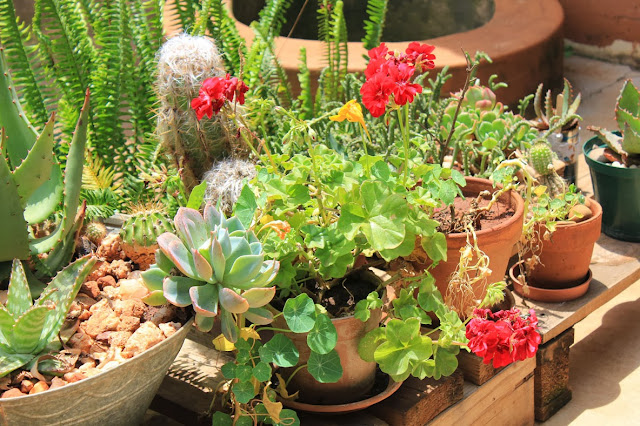


Geranium flower

 Nasturtiums

Arum lily

Naturtiums and a couple of leaves in a bottle of water hanging from a tree - don't keep your flower arrangements for just inside the house - they complement the garden beautifully if hung or placed in strategic spots.

::

Tuesday, 22 October 2013

Salsify (Tragopogon porrifolius)

They say you learn something every day. Today I learnt what Salsify is! 


Walking through my garden at the pond, where I have purely indigenous grasses and leave it fairly wild, I saw what looked like a GIANT DANDELION but upon closer inspection I could see that, besides it's size, there was something different. So off to Google and I'm absolutely thrilled that I have this lovely "vegetable" in my garden!

Salsify (Tragopogon porrifolius) is a common biennial wildflower, native to Mediterranean regions of Europe but introduced elsewhere, for example, into Great Britain, (mainly in the south) and northern Europe, North America, in southern Africa and in Australia; in the United States it is now found growing wild in almost every state, including Hawaii, except in the extreme south-east.


This is a plant with a root that can be eaten. Salsify looks like a giant dandelion, and in a similar fashion the purple flower (some species have a bright yellow flower) turns into a dainty, but LARGE, puffball, dispersing hundreds of seeds into the wind. Salsify is also known as Goat's Beard or Vegetable Oyster as their mild and sweet flavor is often compared to that of oysters. Some say they have a slight asparagus or artichoke taste, with an aftertaste of coconut. The leaves of the salsify plant are edible; this root vegetable is not often seen in supermarkets in South Africa, but is as easy to grow as carrots or parsnips.


• Easy to grow. Sow in garden. Sow seed at a depth approximately three times the diameter of the seed. Best planted at soil temperatures between 10°C and 30°C.
• Space plants: 15 - 20 cm apart
• Harvest in 14-21 weeks.
• Compatible with: Beans, Brassicas, Carrots, Celeriac, Endive, Kohlrabi, Leeks, Lettuce, Alliums, Spinach


It is a fairly slow-growing vegetable but can be harvested in small amounts as required. The ground can be loosened with a fork and a few roots lifted for use.


The plant grows to around 120cm in height. As with other Tragopogon species, its stem is largely un-branched, and the leaves are somewhat grass-like. It exudes a milky juice from the stems.


When buying, choose firm, medium-sized salsify, with no damp parts.

Preparing
:
Both varieties of salsify oxidize when peeled or cut. Immerse them in water mixed with a little lemon juice or vinegar or boil them whole for 15 min before peeling and preparing. Their skin can temporarily stain hands when peeling.

Serving Ideas
:
Salsify and black salsify are delicious in soups and stews or in a gratin, with béchamel or cheese sauce. They can be eaten cold, dressed with a vinaigrette. Salsify goes well with potato, leek, celery, onion and spinach. They are delicious braised with veal, poultry or fish; they can be glazed in the same way as carrots.

Storing
:
Both varieties of salsify are best used fresh. 
In the fridge: several days, unwashed in a loosely closed or perforated plastic bag.

(Image from Good Food) I wasn't going to up-root mine to see what the roots look like!

Cooking
 :
Cook briefly so that the flesh does not become mushy.


Steamed: 10-15 min (recommended 
cooking method).

Boiled: 8-12 min.

Salsify is a good source of potassium and contains vitamin B6, vitamin C, magnesium, folic acid and phosphorus. It also contains inulin (a carbohydrate close to starch), which is suitable for diabetics to eat, as it does not affect blood sugar levels. Salsify is blood thinning and has a decongestant effect on the liver and kidneys.

 Very often mistaken for grass or some obnoxious weed, Salsify is easy to miss. So keep an eye open when weeding, you might be getting rid of your next meal!

.

Saturday, 19 October 2013

Bulbine frutescens

Bulbinel frutesence in my garden, Tarlton, South Africa 
Camera : Kodak EasyShare C195 
Back-ground texture by Kim Klassen

Bulbine frutescens is a popular, waterwise garden plant, especially when planted en masse as a ground cover, or in rock gardens. It is also cultivated for its medicinal properties. (I use the Latin name Bulbine frutescens to avoid confusion as the common names Bulbinella and Bulbine seem to lead to arguments in herbs circles. The plant I mean has long thinnish succulent leaves, and spike-like clusters of small yellow or orange star-shaped flowers.)


This wonderful indigenous plant (native to the desert grasslands of South Africa, it requires well-drained soil and is tolerant of very poor, dry soil) is, like Lavender, an outstanding remedy for minor burns, cuts and abrasions, and insect bites. Simply break off a leaf and squeeze the juice or jelly onto affected areas.


The ease of application makes this an excellent herb to plant with your culinary herbs just outside the kitchen door - not to cook with, but to use for kitchen mishaps like burns and cuts.


The juice of Bulbine frutescens also helps to stop bleeding. Use also for rough and cracked skin and lips, ringworm, and cold sores. Scabies also seems relieved by regular application, but remember that Scabies is caused by a small bug, so any treatment of scabies must be holistic and include thorough laundering and ironing of bedding and clothes (to get rid of family and friends!)


Bulbine is great as an edging plant provided you use something to curb its spreading habit. Plants spread by rhizomes to create lumps. Bulbine self sows freely, so seedlings may appear around the mother plant. Transplant seedlings when they have four leaves and well-formed root systems. Starting new plants is as easy as simply breaking off plantlets and potting them up until they are large enough to be planted in the garden. Division of clumps in spring yields many new plants.

Here I used a log to prevent the Bulbine from spreading into the pathway 

It is a fast growing, branched, succulent perennial with fleshy, linear green leaves in opposite rows and clasping the stems at the base. It forms spreading clumps with greyish stems often bearing adventitious roots. The small 6-petaled star shaped flowers are carried on an upright, spreading raceme during spring (or occasionally at other times). The petals are either yellow or sometimes orange, which combines attractively with the fluffy yellow stamens to give a bi-coloured look. The fruit is a small, rounded capsule and contains black seeds which are dispersed by wind.


Easy to grow, waterwise, and a floriferous groundcover which requires minimum of care, Bulbine will look good all year round. It combines beautifully with blue dwarf agapanthus, flowering at the same time.


Bulbine frutescens is often used in landscaping where a drought-resistant, tough groundcover is required. This succulent perennial multiplies rapidly. Prune it when untidy. For best results it should be planted in well-drained soil preferably enriched with compost. The dead flower heads should be removed to encourage further flowering. These plants prefer full sun, but they will also grow in semi-shade for part of the day. Although it will grow indoors, it requires maximum light.

.

Thursday, 17 October 2013

Cares melt when you kneel in your garden

Soil . . . scoop up a handful of the magic stuff. Look at it closely. What wonders it holds as it lies there in your palm. Tiny sharp grains of sand, little faggots of wood and leaf fiber, infinitely small round pieces of marble, fragments of shell, specks of black carbon, a section of vertebrae from some minute creature. And mingling with it all the dust of countless generations of plants and flowers, trees, animals and – yes – our own, age-long forgotten forebears, gardeners of long ago. Can this incredible composition be the common soil?
 - Stuart Maddox Masters, The Seasons Through 

It's that magic stuff, the soil, that keeps me gardening, and then it is watching each little seedling I planted growing stronger and more beautiful every day, responding to my little chats and watering, feeding and touching - I am convinced that plants respond to attention and affection the same way we humans do, with radiance and a smile! 


Plump, 2 or 3-lobed Nasturtium seeds - I've got a thing for them! I can spend hours sifting through nasturtium plants in search of these little beauties. Just a glimpse of them through the leaves sends me scurrying for a little container. I'm addicted to it. And then the planting of them. It is totally relaxing sitting flat on the freshly-turned ground, poking holes into the soft ground with your finger and dropping the seeds in one by one, knowing that, in just a couple of days, little plants will be popping through. 

Nasturtium seeds peeping through! 


Pure joy as the little plants start appearing! 


Naturtiums in the garden, nasturtiums in pots, nasturtiums everywhere! 

Every winter I bring some of my most prized potted cacti inside for over-wintering and this year I also included a nasturtium to see of I could perhaps prolong the flowering season and have some colour inside. And I did! Even though he (she) got a bit scraggly trying to find sunshine, I was rewarded with lots of flowers, brightening up this little corner in my laundry. Most of the plants, including the Nasturtium, are outside now and enjoying nature again.

::

Tuesday, 15 October 2013

Planting for nature


We choose plants for the garden for a number of reasons, mostly colour, size, texture and how they will fit into the overall design. We tend not to give much thought as to the why's of colour and shape, but one thing is certain, plants do not flower in order to pretty up our gardens! The evolution of flowers was to ensure their survival and that of other wildlife.

When you really love nature, its fauna and flora, gardening takes on a whole new perspective. Keeping wildlife, birds and insects in mind when planting can give immense satisfaction in knowing you are providing food and shelter for them. To achieve this, we need plants as they occur in their natural setting along with the wildlife they support – after all, it is their world too, and the pleasure of having such a strong connection to nature in our own back yards offers health benefits the medicinal world would bottle if they could!


Not many of us give real thought to nature when planting our gardens. The garden is there to give us pleasure, please our aesthetic senses and, to some extent, impress our friends and neighbours.

Many insects, like the Praying Mantis, are beneficial to the garden. It is no wonder they are often referred to as 'the gardener's friend' as they have voracious appetites for insects like moths, crickets, grasshoppers, spiders, aphids and flies, including one another! Your garden's greenery can be a safe haven for them against predators like owls, frogs, chameleons, bats and monkeys.


A Yellow Pansy (Junonia hierta) enjoying minerals in the soil after feeding on some nectar in my garden. This is one of the shiest butterflies around and it is easier to take a photo of a dragonfly up close than to even get near one of these beauties. Male and female similar and females have dots on hind wings. Common throughout South Africa except for most parts of the Cape province. Larval stage feeds on creeping foxglove among others. 


An Orb-web spiderling making its web between two of my plants. I watched this baby building its web in a matter of hours, complete with the characteristic zig-zag pattern in the centre. In South Africa the family Araneidae includes 40 genera of master weavers. There are both diurnal (day) and nocturnal (night) species. The diurnal groups continually repair their webs, usually using them for a number of days. The web cannot be used indefinitely as it dries and loses its capture ability and insects will no longer stick to it. Nocturnal spiders, on the other hand, construct a new web every night and it is taken down at dawn and eaten. This serves as a valuable source of protein. The bridge line, the main original stay that is built, is retained for reuse.


A Speckled Emperor Moth, (Wattled Emperor Moth, Mopane worm) resting on a Restios plant in my garden. It is from the Saturniidae (Silk Moths) family. I actually found her inside the house and brought her out to safety (not sure how SAFE it is...?) and she seemed quite content to just rest a while before disappearing into the thickets. Adult moths lay a single cluster of 50 to 200 eggs around twigs or on the leaves of host plants over a two month period. After approximately ten days, the larvae emerge and then pass through five instars before pupation. Instars I to III of the caterpillars are strictly gregarious and will forage together in aggregations of 20 to 200 individuals. After moulting into instar IV, caterpillars disperse immediately to become solitary. The larval stage lasts approximately 6 weeks, during which time the caterpillars undergo a 4000 fold increase in body mass. At the end of the larval stage, the fifth instar caterpillars burrow into the soil, where they undergo a period of diapause. Eclosion occurs either one or six to seven months after pupation, depending on the generation. The non-feeding adult stage lasts only two to three days, during which time the only function of the imago is to find receptive mates and to oviposit.

Indigenous trees lure birds and provide cover and safety 


Watching the birds as they make their homes in the shelter I have provided leaves me with a sense of achievement, pride and satisfaction. Seeing the Sunbirds visiting the Aloes and taking nectar back to their young warms my heart and watching the bees and other insects pollinate the flowers fills me with a sense of wonder, knowing they are ensuring the future of many plants in the process.


When gardening with nature in mind, do not use pesticides!! Most of these products are not selective and in spraying to kill what the gardener perceives as ‘pests’, will usually result in getting rid of the beneficial insects too. Use indigenous plants, preferably a good selection of local species, including nectar and pollen rich plants as they are of great value to bees, as bees around the world are disappearing at an alarming rate.


Indigenous grasses provide safety for many of our insects - this is a Net-winged beetle I found in my garden. Net-winged beetles or flat beetles (Lycus spp.) are all poisonous and therefore display aposematic colouration in combinations of orange and black patterns, which is mimicked by certain long-horn beetles and moths. The longitudinal ridges on the wings are characteristic of the net-winged beetles. They are slow flying insects that are very common on flower inflorescences and flower heads during the summer months. The larvae are predatory on other insects and look very similar to the larvae of the glow worms or fire flies. Eggs are laid under bark and in rotten wood, where the eggs will hatch and the larvae start feeding on other insects. 

Try not to plant hybridised plants - many hybridised plants have far less pollen and nectar and are thus not efficient providers of food. Many of them also have double petals, and, as lovely as they are to look at, it often makes life very difficult for the bees and insects to get to their food source.


A Grey-headed Bush Shrike (Malaconotus blanchoti) surveying his surrounds from one of the Karee's. An adaptable hunter, it will eat almost any animal that it can catch and kill, ranging from small insects to large 1 metre long snakes and other bird chicks. It often gleans prey from leaves and branches, either eating them immediately or impaling them on a thorn to be eaten later. Prey items which are to large to be swallowed are ripped into bite-sized pieces. 

 
The Ground-scraper Thrush absolutely loves loose leaf litter and is very active in Autumn and Spring when leaves tend to cover the ground. He is also a snail's worst nightmare and I often watch as they catch one, banging it against the ground until the shell is broken and he can consume the tit-bit inside.

When you plant for nature and not just yourself, you will be rewarded by having the best of both worlds - a beautiful garden as well as the company of a varied variety of wildlife. Who could ask for more?

.

Saturday, 12 October 2013

My sedges (Cyperaceae)

 Sedges growing amongst the paving in my garden

I have these beautiful, what I thought was grasses, springing up all over in my bathroom court-yard, but upon trying to identify them, found out that they are sedges. Grasses are characterised by 'nodes' along the stem - or jointed stems - as opposed to 'sedges' which have stems with no joints and which belong to another family. 

As in grasses, the basic unit of the inflorescence in sedges is the spikelet. Within the family there is enormous variation in spikelet and inflorescence structure. The spikelet consists of one to several, tiny, male, female or bisexual flowers, each borne in the axil of a boat-shaped glume (tiny bract) which is coloured in shades of green or brown, red, occasionally white or bright yellow. Mostly petals are absent, but when present, they are concealed within the glume and consist of bristles or scale-like structures. 

 
Distribution
The family comprises about 104 genera and more than 5 000 species world-wide, although estimates of numbers vary greatly due to differing taxonomic concepts of individual researchers and because modern sedge floras are available for only a few countries. The largest genus is Carex with about 2 000 species world-wide, followed by Cyperus with about 550 species. Sedges occur primarily in the tropics and subtropics, but may be locally dominant in some areas like the subarctic regions (tundra). 

In rather arid southern Africa there are roughly 40 genera and 400 species. They are found throughout the region, in particular habitats. Some species e.g. in the genus Tetraria are endemic (occur nowhere else in the world) to the winter rainfall region of the Western Cape, South Africa. 


Ecology
In southern Africa sedges are found mainly in wetlands (some are entirely aquatic) and along watercourses, but also occur in moist grasslands and along forest margins. Some genera (e.g. Tetraria) are common constituents of fynbos vegetation, which generally occurs on impoverished sandstone soils, whereas several species of other genera are pioneers on coastal dune sands. 

It is not surprising that adaptations to particular habitats are many. Many species are deciduous, and survive the unfavourable season as rhizomes, corms or tubers. Several species grow in semi-arid areas, and are able to survive periods of drought due to succulent, water-storing leaf sheaths. In arid areas many species have overcome the problem of temporary moisture (such as in pans) by becoming annuals, completing their life cycles in a month or two. Species occurring in fire-regulated grasslands often have protectively thickened and hardened or fibrous leaf sheaths. 


Sedges are generally wind pollinated, although some of the brightly coloured species are thought to be insect-pollinated. On several occasions I have observed thrips (tiny insects) in the flowers of Fuirena species, absolutely covered in pollen. It is almost certain that, as well as feeding on the pollen, they are also vectors. After disintegration of the spikelet the fruits are mostly dispersed by wind and water, and can also be carried long distances in mud on the feet of migrating birds. Some fruits have corky flotation tissue or further adaptations for water dispersal, some have elaiosomes (an oil-rich appendage on the seed) for ant dispersal, and others are equipped with tiny hooks and bristles for dispersal in the fur and feathers of mammals and birds. 

 
Economic and cultural value
The chief importance of sedges lies in their forming a major natural constituent of wetlands and riverside vegetation, where their densely tangled rhizomes contribute to erosion control and water purification. The consequences once they are eradicated are unfortunately all too easily observed. While on the natural theme, the dense sedge beds that form in swampy regions provide food and shelter for birds, animals and other aquatic life-thus attracting ecotourism. In grasslands, terrestrial game birds (e.g. francolin) feed almost exclusively on the small corms of some Cyperus species. 
Info from PlantzAfrica 


And here's the thing - termites absolutely love these sedges! A couple of days after taking these photo's, most of my sedges were all but gone. I sat for hours watching the termites chew a stalk off at the base, then cutting them into one-inch pieces and carry them down their hole. Termites are sometimes a big worry in my garden as I don't use any chemicals or poisons whatsoever. Termites are extremely nutritious as they have a good store of both fat and protein and are a nutritional food source for all kinds of animals from birds, to reptiles, to mammals.


But some new sedges are already springing up after the rain and now I sprinkle some diatomaceous earth around each plant, as well as where I suspect the termite holes to be. Diatomaceous Earth (DE) is the remains of microscopic one-celled plants (phytoplankton) called diatoms that lived in the oceans and lakes that once covered the western part of the US and other parts of the world. I also use it in the garden to keep snails and insects at bay as well as in my chicken coop as a control against mites, lice, mosquitoes and other harmful insects.

 ::

Related Posts Plugin for WordPress, Blogger...