Showing posts with label bird of paradise. Show all posts

Saturday, 2 February 2019

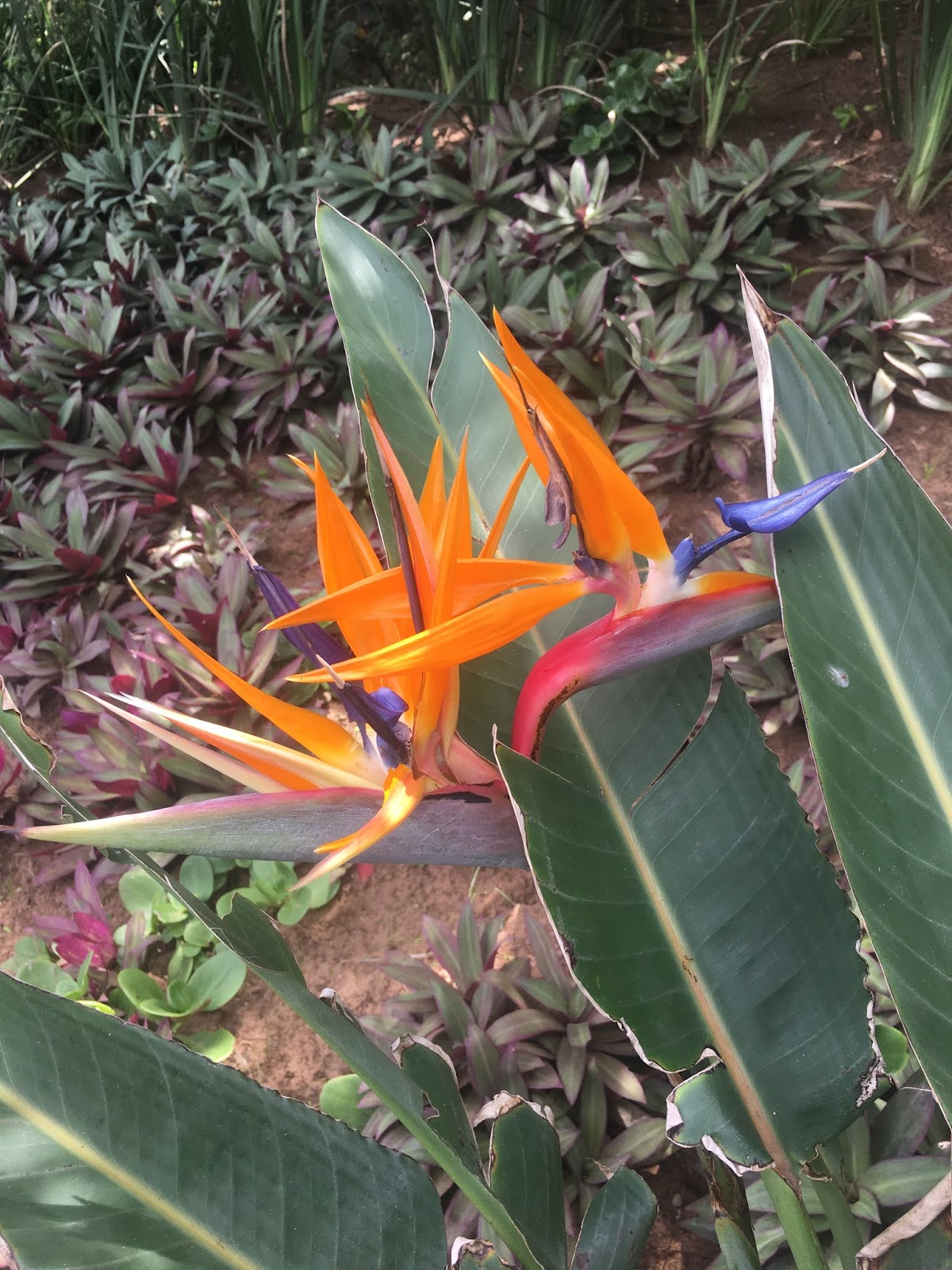
Strelitzia reginae (Bird of Paradise)

(Pic taken with my iPhone 6s Plus in Sheffield, Ballito, KwaZulu Natal)

Strelitzia reginae, the crane flower or bird of paradise, is indigenous to South Africa. An evergreen perennial, it is widely cultivated for its dramatic flowers. In temperate areas it is a popular houseplant.

(Pic taken with my iPhone 6s Plus in Sheffield, Ballito, KwaZulu Natal)
 
After many, many attempts of growing this beautiful plant in my previous garden in Tarlton, Gauteng (South Africa) and having it frosted down to the ground every year until it succumbed to the cold winters, I am now totally surrounded by masses of these plants here in Ballito. I just can not get enough of looking at the intricacies of the flower, it truly could be a bird of paradise and take to the skies any minute!

Strelitzia reginae is one the most popular horticultural perennials around the world. It flowers for long periods with its vivid orange and bright purple/blue inflorescence and is an ideal pot plant and cut flower subject. The inflorescence stalk is 700 mm tall with 4-6 flowers that emerge in succession in a boat-shaped spathe ± 200 mm long, producing a mucilaginous substance when in bloom. The flowers have orange sepals and blue/purple petals (May to December). 

It occurs naturally only in South Africa along the eastern coast from Humansdorp to northern KwaZulu-Natal in coastal bush and thicket. It grows along river banks in full sun, however sometimes it occurs and flowers on margins of forest in shade.

Bees are common visitors when the spathe is in flower. Sunbirds may be the pollinator, but this has still to be proven. The role of sunbirds in Strelitzia pollination needs to be investigated, as they have been observed "robbing" the flowers by taking nectar but by-passing the pollination mechanism. Birds eat and disperse the seed. In nature, where its distribution overlaps with that of  S. juncea, in the Humansdorp District, they hybridise easily.
(This info from SANBI)

It is regarded as a perennial herb by the abakwaMthethwa clan in KwaZulu-Natal, who use the strained concoctions from the inflorescence to treat inflamed glands and venereal diseases. The seeds are also used in the Cape to sour milk.

Read more about Growing Strelitzia reginae here.


Special Features of Strelitzia reginae :

Attracts birds
Drought resistant
Feature plant
Good pot plant
Medical plant
Useful plant
Feeds honeybees
 

Tuesday, 18 September 2018

Strelitzia nicolai

(Camera Canon EOS 550D - Sheffield, Ballito, KwaZulu Natal, South Africa)

The Natal Wild Banana (Strelitzia nicolai) grows up to 12m high and 4m wide. It is an evergreen tree with multi-stems that form dense clumps.

Taken in my garden, Sheffield, Ballito, South Africa

The stem is woody and smooth in texture. It is light to dark grey and marked with old leaf scars. Attached to the stem by long, thick leaf stalks are the enormous, opposite leaves that are shiny and grey-green, with blades capable of reaching up to 2m in length. These tear in the wind and come to resemble giant feathers.

Camera Canon EOS 550D - Sheffield, Ballito, KwaZulu Natal, South Africa

The inflorescence is composed of a dark blue bract, white sepals and a bluish-purple "tongue". The entire flower can be as much as 18 cm (7.1 in) high by 45 cm (18 in) long and is typically held just above the point where the leaf fan emerges from the stem. Flowers are followed by triangular seed capsules.

Pic from Wikipedia

The flower of the Natal Wild Banana is a typical Crane Flower inflorescence, up to 500 mm long. The flowers of this tree have white sepals with blue petals and consist of 5 purplish blue, boat-shape sheaths.The whole flower resembles the head of the bird, with a white crest and purple beak. The tree flowers throughout the year with a peak in spring-summer. The inflorescence is compound (more than one flower).

The seeds are black in colour, with a tuft of a bright orange woolly aril on the lobe. They are produced mostly in autumn and winter, March to July. The easiest way to propagate this tree is from root suckers, but it will also grow from seed.

Restricted to evergreen coastal forest and thicket of eastern South Africa from the Great Fish River northwards to Richards Bay. It is also considered native to Mozambique, Botswana and Zimbabwe, and is reportedly naturalized in eastern Mexico.

Strelitzia Nicolai is among the few plants which have been verified to contain the pigment bilirubin, which is usually found in animals.
Related Posts Plugin for WordPress, Blogger...