Africa loves to paint her winter landscape in orange and yellow hues, and her exuberance is infectious. Nothing beautifies the winter garden like the bright splashes of colour supplied by Aloes. Every winter I'm blessed with the beauty of these flowers, but this winter has been very extreme and I've only got one flowering, on the other two the flowers got caught by the frost just as they were emerging.
The Cape Aloe (Aloe ferox) is known as one of the most potent healing plants known to man. This uniquely South African Aloe grows naturally in semi-dessert conditions on the hills of the Eastern Cape.
It is a distinctly handsome plant, with broad, lance-shaped, fleshy leaves with spines on the edge. In its natural habitat or in the frost-free garden it can attain great size, 2 to 3 meters in height with the leaves arranged in a rosette. They are often grown indoors where they can thrive in consistently warm temperatures. The leaves vary, sometimes with a slightly blue look or a reddish tinge and sometimes they appear spotted.
The flowers are carried in a large candelabra-like flower-head. There are usually between five and eight branches, each carrying a spike-like head of many flowers. Flower colour varies from yellowy-orange to bright red and occurs between May and August, but in colder parts this may be delayed until September.
Two of my aloes in full flower last winter
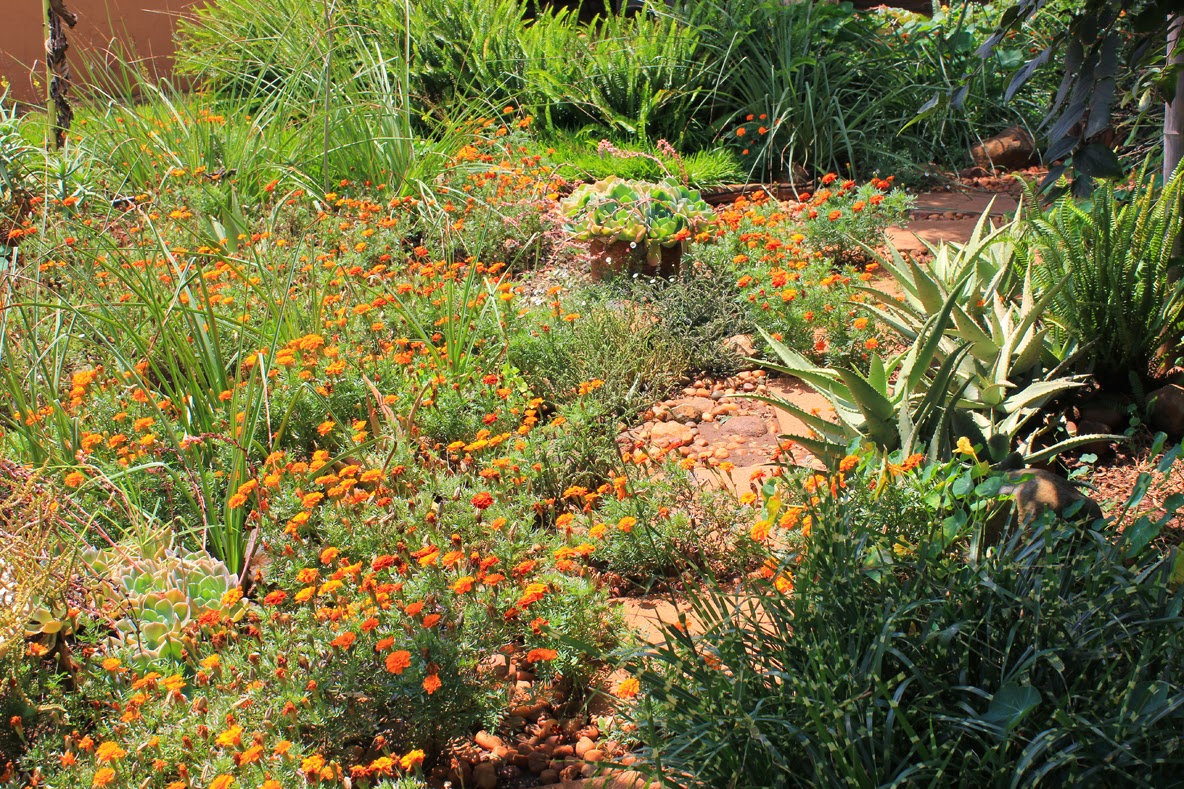
Because Aloe plants consist of 95% water, they are frost tender. If they are grown outdoors in warm climates, they should be planted in full sun, or light shade. The soil should be moderately fertile and fast draining. Established plants will survive a drought quite well. If you live in a more temperate are it's best to leave your Aloe plant in a pot, indoors and place it near a window that gets a lot of sun. You can move the pot outdoors during the summer months. Grown with Agave, cacti or other succulents, they make stunning displays.
Aloe ferox in summer
People get Aloe Ferox confused with Aloe Vera - Vera products are made of Aloe found in America, whereas the Ferox grows indigenously in South Africa. Aloe ferox has more vitamins, minerals, amino acids and polysaccharides than Aloe Vera. Aloe Ferox contains two principle ingredients: Aloe gel, the white inner fleshy part of the leaf and Aloe bitters, which are not readily available from Aloe Vera. Aloe gel drains from the leaf of the plant when cut. It is well known for its superior antiseptic, cleansing, moisturizing and anti-inflammatory properties. The dark sap comes from between the green peel and the white jelly of the leaf. The “bitters” or "Schwedenbitters" are used for their laxative qualities and to treat arthritis.

After flowering, the flower stalks are covered in seeds. These can be collected and dried, ready to be planted in pots or somewhere in the garden. The seeds also disperse naturally and you will find many pups appearing all over your garden. Be aware that aloes will hybridise with any other aloe flowering at the same time. I have quite a few "unknown" aloes in my garden because of this hybridisation.
Aloe ferox pups growing from seeds dispersed by the wind or birds. These are now ready to be transplanted, will find a nice, sunny spot for them in spring.
Sowing:
Sow indoors at any time of year.
Fill small pots or trays with a light and well drained compost. Stand the pots in water, moisten thoroughly and drain. Scatter the seed onto the top of the compost and cover lightly with sand. Care should be taken to prevent the pots drying out.
The majority of seeds germinate at temperatures of 22 to 24°C (70 to 75°F). Some seedlings may appear at around 30 days others will take longer, up to 180 days.
Once germination has taken place, move into a good light. Be careful to keep the top of the compost damp but watch out for overwatering as the seedlings could rot. Transplant into pots once they are about 4cm high (6 months). Always use a pot with a hole and put a layer of small gravel at the bottom of the pot and also one inch on the top of the soil to prevent stem rot.
Transplanting:
Aloes have a shallow, spreading root system, so when it is time to repot choose a wide planter, rather than a deep one. Use a planter with a drainage hole, or provide a 3 to 5cm (1 to 2in) layer of gravel in the bottom of the pot to ensure adequate drainage. Use a good commercial potting mix with extra perlite, granite grit, or coarse sand added. You may also use a packaged 'cacti mix' soil.
Cultivation:
During the winter months, the plant will become dormant, and utilise very little moisture. During this period watering should be minimal. Allow the soil to become completely dry before giving the plant warm water. During the summer months, the soil should be completely soaked, but then be allowed to dry again before re-watering. If you use rainwater, be careful as it could be acidic.
Fertilise yearly, in the spring with a dilute (½ strength), bloom fertilizer (10-40-10). Aloes are easily grown from seeds, but also can be propagated by removing the offsets produced around the base of mature plants, when they are a couple inches tall.
Medicinal Uses:
Aloe effectively regenerates injured nerves and new skin cells. It is commonly used to soothe burns, including sunburn and radiation burns. Aloe is also applied to wounds, insect bites, eczema, ringworm, rashes, leg ulcerations and severe acne. It is also used to reduce the pain and swelling of arthritis and rheumatism. Aloe is also used to treat headache, dizziness, constipation and insomnia. Aloe gel is perishable. Freeze the fresh gel in small blocks and defrost before use.
There are more than 450 species of aloe plants, varying in size from diminutive pot plants to large clumps. They inhabit dry, often rocky and exposed areas.
There is an ongoing debate as to whether aloes and their close relatives should be placed in the family Asphodelaceae, Liliaceae, or Aloaceae.
::